A San Antonio practice owner told me last month: “We’re covered. We pay for SEO.”
Fair. But I asked where his clients found him last year. The list: a Google search, a Google Maps result, a referral in a neighborhood Facebook group, a mention in a local news piece, one who “asked ChatGPT,” and three word-of-mouth.
Seven paths. His SEO covered one and a half of them.
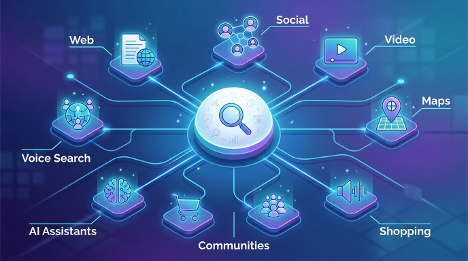
Many business owners think SEO alone is enough to attract new clients, but people use multiple channels, including search engines, maps, social media, news, AI assistants, and word-of-mouth. Standard SEO usually covers only a fraction of these areas. To reach customers wherever they are, companies must keep information accurate and consistent across platforms, build trust through diverse, credible sources, and go beyond directory listings and paid link schemes. Business owners should track how new clients find them and actively manage multiple search channels.
I call the work of connecting these surfaces Search Channel Optimization (SCO). It isn’t a replacement for SEO—SEO is necessary; it’s just incomplete on its own. SCO is the layer that aligns those surfaces into a single identity, and trust is the signal that holds that alignment together.
What that looks like in practice:
– Your entity facts—name, address, services, and credentials—are identical everywhere, not just close to identical.
– Your reputation is corroborated in more than one place, not concentrated in Google reviews alone.
– Your expertise is attributed to a named person with verifiable credentials, not an anonymous “our team.”
– Your structured data says what your page says, because a human reading your site and a crawler parsing it are two different audiences.
– Your independent mentions are relevant and real, because one credible source outperforms fifty directory listings.
One thing I’ll say plainly: bulk directory submissions and paid link packages don’t build this. They’re the thing that looks like proof without being proof.
If you’re a South Texas firm spending on search but not sure what it’s covering, sit down and list every way a client found you in the past year—just ask them how they first heard about you. Then look at that list and note which of those channels anyone is actively working on.
Most owners find the honest answer is one.